
 English US
 English UK
 English AU
 English SG
 Français
 Deutsch
 Italiano
 Español
 Nederlands
Global E-Invoicing Solutions for Supplier & Customer Invoices
Standardise, automate and scale global e-invoicing with one platform for accounts payable and invoice delivery. Esker helps Finance teams stay compliant worldwide while improving visibility, control, efficiency and cashflow.
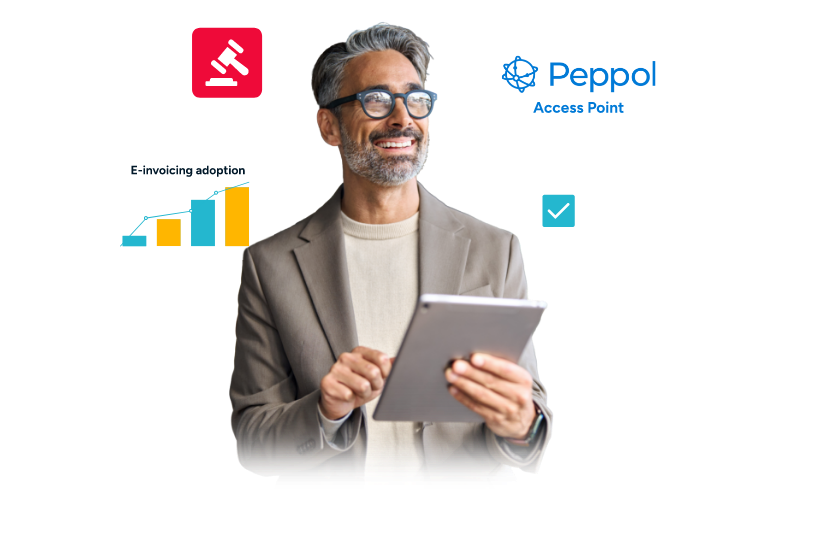


One platform for compliant invoice workflows worldwide
Global electronic invoicing is no longer just about compliance.
It’s an opportunity to standardise invoice operations, automate workflows, and gain greater visibility across supplier and customer invoicing, which creates a stronger global foundation for finance performance, control and scalability.



Global compliance coverage
- Regulatory compliance coverage worldwide
- 60+ countries supported
- EDI, Peppol and interoperability support
- Compliance support without creating local silos

Drive finance performance
- Standardise invoice workflows across countries and entities
- Reduce manual data entry, operational costs and disconnected workflows
- Improve visibility across customer and supplier invoicing
- Strengthen control, traceability, productivity and audit readiness

Unified & scalable platform
- Simplify the management of global invoicing across countries and entities
- Centralise global accounts payable (AP) and accounts receivable (AR) on one platform
- Seamless integration with major ERP and finance systems
- Secure, scalable and audit-ready
One electronic invoicing platform for supplier & customer invoices
Esker brings together customer invoice delivery and supplier e-invoicing on one platform, helping organisations standardise and automate both AP and invoice delivery worldwide.
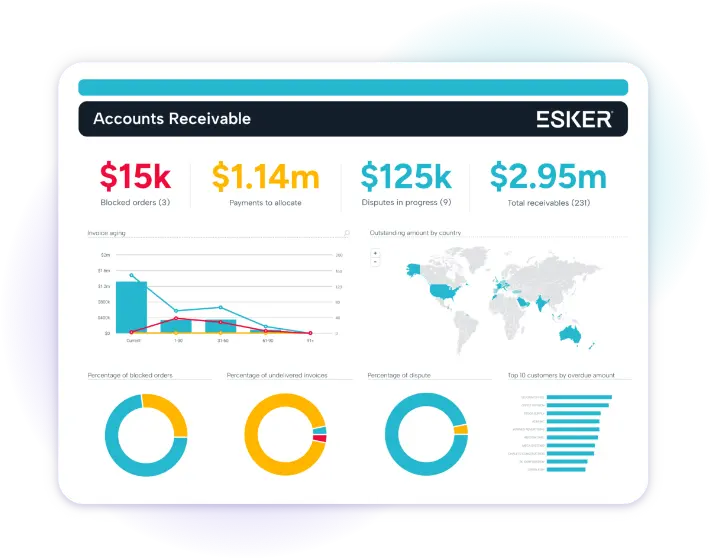
Invoice delivery for accounts receivable teams
Send customer invoices quickly and reliably through the right channels and in the right formats with the visibility needed to manage invoice delivery at scale.
- Deliver invoices in compliant formats
- Track delivery status and invoice exceptions
- Connect customer invoicing with end-to-end order-to-cash processes
Accounts payable for supplier invoice processing
Automate supplier invoice receipt and processing with greater control over invoice data, routing and workflows across AP operations.
- Capture and process supplier invoices more efficiently
- Reduce manual invoice handling and validation efforts
- Connect supplier invoicing to end-to-end source-to-pay processes


McDonald’s Force: Balancing compliance, performance & operational efficiency
Thanks to Esker’s AI-powered solutions, McDonald’s Force is now driving operational efficiency and regulatory readiness through finance automation.

Navigate worldwide e-invoicing mandates with confidence
As governments worldwide expand e-invoicing mandates to improve tax compliance and reduce fraud, organisations need a scalable approach to managing evolving requirements. Esker helps businesses stay ahead with global compliance coverage, interoperability and centralised visibility across invoice operations.

Key capabilities that help simplify compliance & maintain control across global invoice processes:

Regulatory readiness
without disrupting existing workflows

Global coverage
across local models and country-specific requirements

End-to-end visibility
across AP and AR invoice flows

Interoperability
across platforms, networks, Peppol and e-invoicing formats

A future-ready approach
to evolving e-invoicing regulations
Built for interoperability, security & scalability
Esker combines interoperability, security and governance capabilities to support compliant invoice operations worldwide. From secure invoice exchange to audit-ready traceability and ERP connectivity, organisations gain the control and visibility needed to manage invoicing at scale.
Built to support secure invoice exchange, interoperability and finance governance:
- Connectivity with ERP and finance systems
- Traceable invoice flows and complete audit trails
- Invoice integrity and authenticity respected
- Secure exchange and controlled invoice routing
- Support for Peppol, multiple e-invoicing formats and interoperability
- Finance governance and operational control capabilities
- Compliant archiving and long-term document traceability
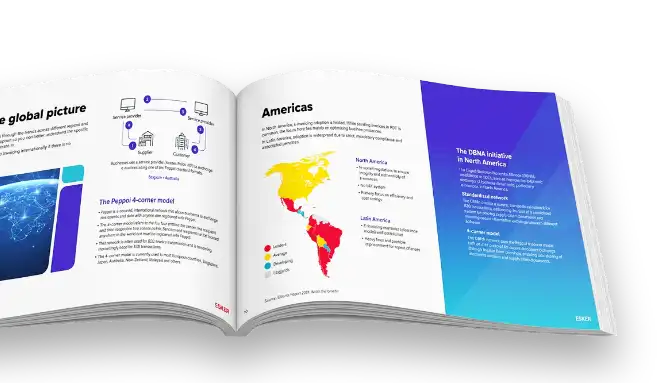
EBOOK
Get the guide to global e‑invoicing readiness
Explore the main global e-invoicing models, emerging compliance trends and the key capabilities businesses should look for in a scalable platform strategy.
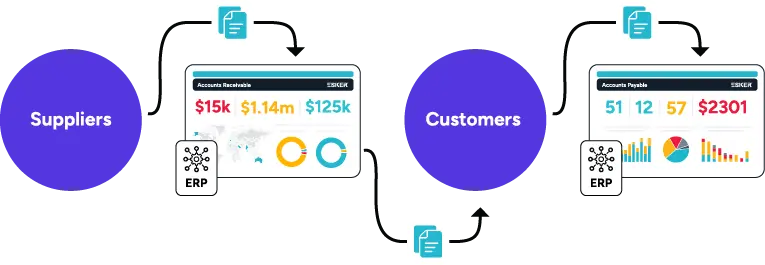
Invoice management software
How Esker orchestrates end-to-end e-invoicing
Esker helps organisations manage AP and invoice delivery as connected, end‑to‑end e-invoicing processes, from invoice capture and validation to formatting, routing, status visibility and compliant archiving.
01
Capture & source invoice data
Connect supplier and customer invoice data from ERP systems, finance applications, portals, networks and other business sources.
02
Validate & enrich invoice data
Validate invoice data, apply business rules, and improve data quality to support compliant processing and structured invoice exchange.
03
Format & exchange invoices correctly
Receive and send invoices in the required formats through the appropriate platforms, interoperability networks and e-invoicing models.
04
Track status, visibility & archiving
Monitor invoice statuses and exceptions, maintain end-to-end traceability, and support compliant archiving and audit readiness across invoice flows.
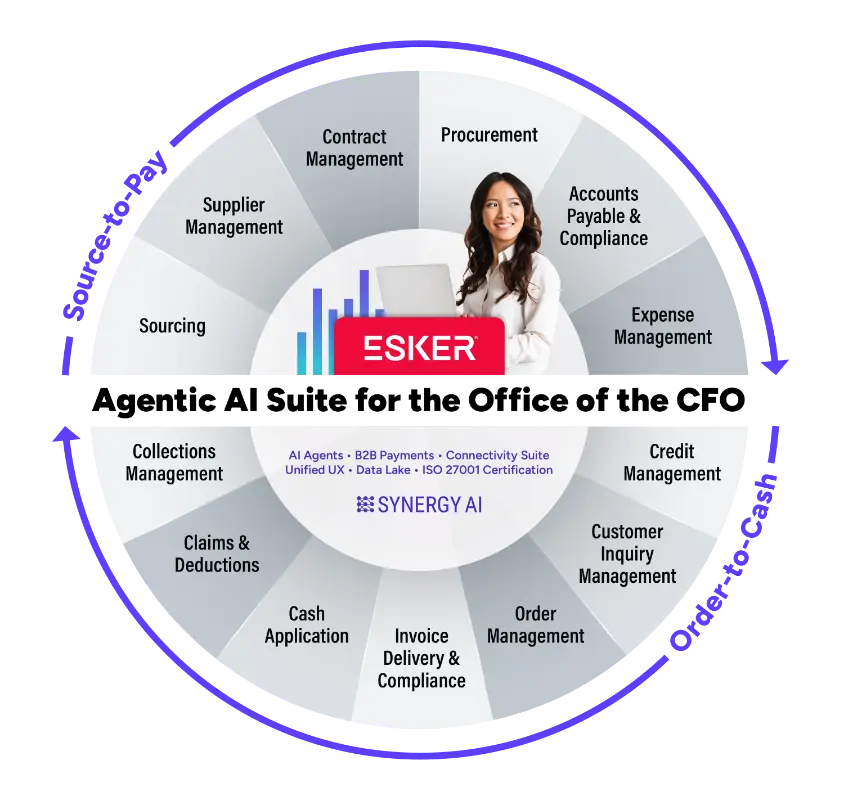
Empower the Office of the CFO across order-to-cash & source-to-pay processes
E-invoicing is more than a standalone compliance requirement. Esker connects e‑invoicing with broader finance operations, helping organisations extend value across both customer and supplier processes.
For supplier invoice workflows
Align e-invoicing solutions with source-to-pay priorities to improve supplier invoice processing, automation, control and operational efficiency.
For customer invoice workflows
Align e-invoicing solutions with order-to-cash priorities to improve invoice delivery, customer experience, payment visibility and cash collection readiness.
With Esker, e-invoicing becomes part of a broader finance transformation strategy, not just a response to local compliance mandates.

Unify global e-invoicing, AP & AR on a single platform
Talk to Esker about managing supplier and customer invoicing with more control and global compliance readiness.
Frequently asked questions
What is e-invoicing software?
E-invoicing software helps organisations create, exchange, route and manage invoice data in structured or compliant formats. It can also support interoperability, reporting obligations and operational visibility across invoice flows.
Is e-invoicing only about compliance?
No. While compliance is a major driver, e-invoicing software also helps standardise invoice operations, reduce manual processing, improve visibility and support broader finance transformation.
What is the difference between AP and AR e-invoicing?
AP (Accounts Payable) e-invoicing focuses on supplier invoice receipt, validation and processing. AR (Accounts Receivable) e-invoicing focuses on sending compliant customer invoices and managing delivery across different channels, formats and country requirements.
Can one platform support both supplier and customer invoicing?
Yes. Esker supports both sides of invoice operations, helping organisations manage supplier invoice flows and customer invoice delivery on one platform, unlike many soutions that focus only on a single part of the process.
How does e-invoicing software support country-specific requirements?
It can support local formats, platforms exchanges, routing models, and interoperability needs, while helping organisations keep invoice operations more consistent across countries.
Does e-invoicing software need to connect to ERP systems?
Yes. ERP connectivity is important because invoice data, validation, routing and finance workflows need to stay aligned with the systems businesses already use. Esker is designed to integrate seamlessly with major ERP and finance environments.
What is the role of Peppol and tax platforms?
Peppol and tax platforms help ensure compliant and secure e-invoice exchange between businesses and government authorities.
- Peppol is a standardised network that enables companies to send and receive e-invoices in a common format across countries through Peppol Access Points. It simplifies interoperability and supports international compliance requirements.
- Tax platforms (often government-mandated) validate, monitor, or report invoice data to tax authorities in real time or near real time to support VAT compliance, clearance, and continuous transaction controls (CTC).
Together, they help organisations automate e-invoicing processes, reduce compliance risks, and adapt to evolving global regulations.
Is e-invoicing relevant in countries without a mandate?
Yes. Even where mandates are not yet in place, e-invoicing can help organisations standardise invoice flows, reduce manual work and prepare for future regulatory change.
What software is used for e-invoicing?
E-invoicing is usually handled by different types of software: accounting software, ERP systems, and AP and AR automation solutions.
Roi calculator
See how much you can save with Esker's automation solutions