
 English US
 English UK
 English AU
 English SG
 Français
 Deutsch
 Italiano
 Español
 Nederlands
E-Invoicing in Italy
Prepare for Italy’s e-invoicing framework with a clearer view of the local model, compliance requirements and the role of the Sistema di Interscambio (SdI) platform. Italy pioneered mandatory nationwide B2B e-invoicing in the European Union.
*This page is intended as a practical overview only. Requirements, rules, timelines and technical specifications may change as the regulation evolves.



Italy e-invoicing requirements at a glance
From e-invoicing model selection to rollout timing, these are the key factors businesses should consider when preparing for Italy's mandatory e-invoicing obligations.
Current status — Live and mandatory
Scope — B2B, B2G and B2C transactions
The reform covers all domestic transactions.
Cross-border transactions must also be reported.Format — FatturaPA format
Invoices must be issued in the FatturaPA format (specific structured XML format).
Archiving — 10 years
The invoice archiving period is 10 years from invoice date.
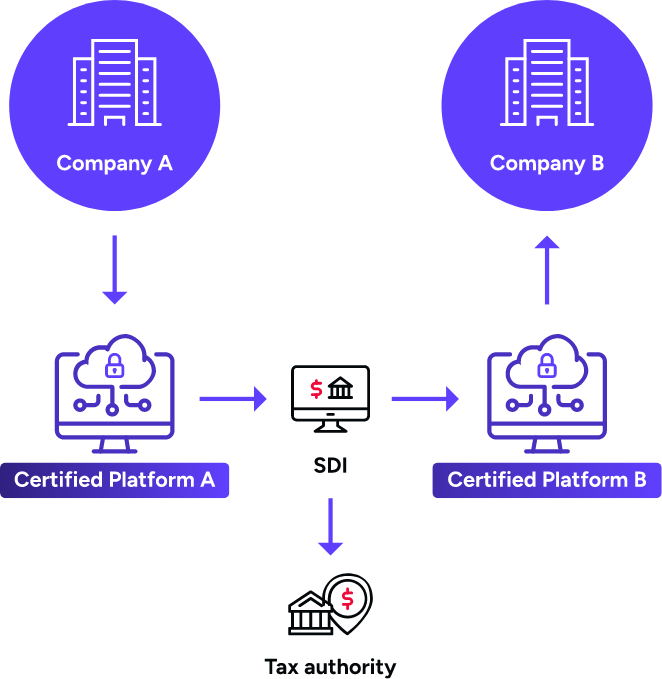
Transmission method — certified platforms and SdI
E-invoices must be transmitted through certified service providers, which submit invoices to the public invoicing platform SdI.
Italy e-invoicing timeline & key dates
Italy’s e-invoicing journey began with public administration and has since expanded to include nearly all taxpayers, including micro-enterprises and cross-border reporting.

January 2019
E-invoicing became mandatory for all domestic B2B and B2C transactions through Italy's SdI platform.

July 2022
Businesses were required to report cross-border transactions through the SdI platform, replacing the previous Esterometro reporting system.

January 2024
The e-invoicing mandate was extended to all VAT-registered businesses, including those under the flat-rate tax regime. All businesses are required to issue and receive electronic invoices via SdI.
Implementation dates and requirements may evolve as regulations, technical specifications and administrative guidance continue to develop.
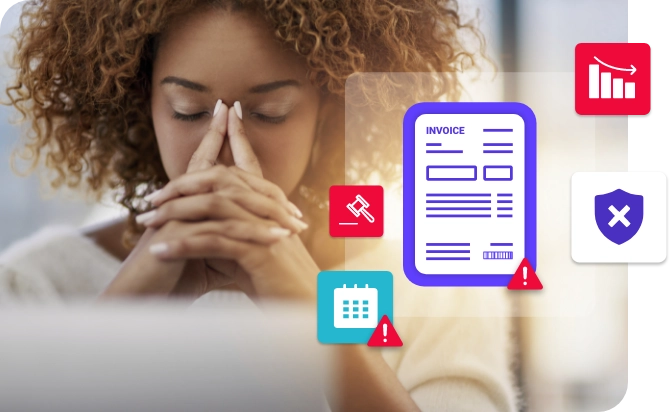
Non-compliance may lead to sanctions
Italy’s e-invoicing reform includes administrative penalties for businesses that fail to comply. Potential compliance risks include:
- Failure to issue compliant e-invoices
- Missing reporting or submission obligations
- Using non-compliant e-invoicing platforms
- Lacking sufficient invoice traceability or archiving procedures
EBOOK
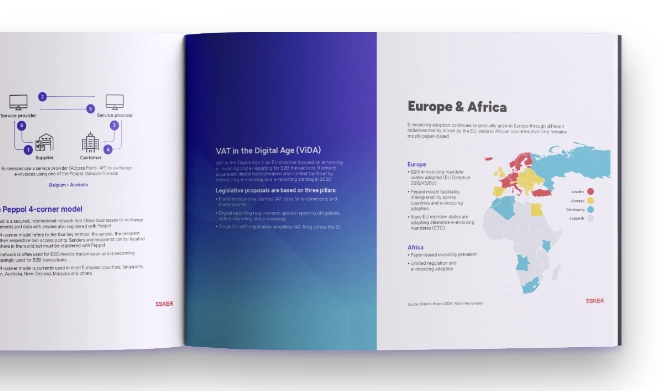
Get the guide to global e‑invoicing readiness
Explore the main global e-invoicing models, emerging compliance trends, and the key capabilities businesses need to build a scalable platform strategy.
What Italy’s e-invoicing reform changes for businesses
Italy’s reform changes how invoice data is exchanged, routed, and reported. Businesses need the right operational setup, and compliance model to prepare effectively and support a smoother rollout.

Anticipate operational changes
Italy’s mandate affects how teams manage invoice data, workflows, and trading partner interactions. Applying the new requirements consistently can help reduce disruption and support smoother day-to-day operations.
- Review invoice content, data and required fields
- Align ERP and invoicing workflows
- Coordinate customer and supplier invoicing processes
- Meet invoice traceability and archiving requirements

Choose the right compliance approach
Italy’s model introduces specific requirements around platforms, structured formats, and the exchange model. Businesses need an approach that supports the local regulatory framework while remaining scalable over time.
- Support local invoice formats
- Connect to the right platform environment
- Manage interoperability and invoice exchange requirements
- Scale with future regulatory changes
Why choose Esker for e-invoicing in Italy
Choosing the right e-invoicing solution in Italy is about more than meeting regulatory requirements. Businesses need a platform that supports local compliance while improving visibility, control, and efficiency across invoice operations.
Built for customer and supplier invoice workflows
Esker supports both customer invoice issuance and supplier invoice processing within a single integrated platform.
Designed for compliance and interoperability
Esker helps businesses manage structured invoice formats, platform environments, interoperability requirements, and evolving Italian e-invoicing obligations through one scalable platform.
Enable broader finance transformation initiatives
Esker extends e-invoicing readiness into wider accounts payable, accounts receivable, source-to-pay, and order-to-cash transformation projects across the business.
Prepare for future EU regulatory changes (ViDA)
Esker helps businesses prepare for upcoming initiatives such as VAT in the Digital Age (ViDA) and adapt more easily to harmonized EU e-invoicing requirements.
Send us a message
Please fill in the form below to get in touch with us.
Automate invoice operations. Stay compliant from day one.
Deploy Esker Accounts Payable and Esker Invoice Delivery to streamline invoice operations, improve visibility, and ensure compliance with current and future requirements.
Key benefits:

Improve supplier and customer invoice processes

Strengthen invoice data quality and workflow foundations

Prepare for future platform and interoperability requirements

Activate compliance capabilities



Frequently asked questions
Is e-invoicing mandatory in Italy?
Yes, e-invoicing is mandatory for all domestic B2G, B2B, and B2C transactions. This requirement applies to all VAT-registered businesses established in Italy. For B2G invoices in Italy, suppliers must issue electronic invoices through Italy’s Sistema di Interscambio (SdI) using the FatturaPA format. The B2G mandate has applied broadly to public administrations since March 2015.
What is the electronic invoicing system in Italy?
The system is called the Sistema di Interscambio (SdI). It is a centralized platform, managed by the Agenzia delle Entrate, that validates and transmits e-invoices in the FatturaPA XML format between suppliers and customers.
When did Italy introduce mandatory e-invoicing?
Italy introduced mandatory B2G e-invoicing in March 2015. The mandate was extended to B2B and B2C transactions on January 1, 2019, making Italy a pioneer in European e-invoicing.
How long must e-invoices be archived in Italy?
E-invoices must be archived for 10 years in Italy to maintain compliance.
Why was B2B and B2C electronic invoicing introduced?
In 2019, Italy introduced mandatory B2B and B2C e-invoicing to make commercial transactions and tax document management simpler, more transparent, and easier to monitor. Italy was the first EU country to introduce mandatory e-invoicing for these transactions, driven by several goals: simplify tax processes, reduce administrative burdens, and help prevent tax evasion and VAT fraud.
Choosing a cloud-based solution for B2B and B2C electronic invoicing helps companies manage invoice operations with greater simplicity, visibility and transparency for both customers and suppliers.
Is Esker compliant with Italy’s NSO mandate?
Esker’s cloud platform supports B2B and B2C e-invoicing and is compatible with Italy’s National Health Service (SSN), electronic order management requirements through the Nodo Smistamento Ordini (NSO) platform, which is based on PEPPOL. Esker's solutions integrate with corporate systems and manage all types of electronic formats.
The advantages for businesses include:
- Manage all orders from the same interface, regardless of channel or format
- Gain real-time visibility into all orders, including NSO orders
- Manage pre-arranged NSO orders directly from your standard order management solution
- Support compliance with Italy's 2018 Budget Law