

 English US
 English UK
 English AU
 English SG
 Français
 Deutsch
 Italiano
 Español
 Nederlands
5 AR Tasks AI Can Handle So Your Team Can Focus on Customers

Today’s accounts receivable (AR) teams face familiar challenges: growing workloads, increasing customer expectations and constant pressure to improve performance — often without the aid of additional headcount.
As invoice volumes rise and customer interactions become more complex, many AR teams find themselves spending less time on strategic collections activities and more time on tedious administrative work, such as reviewing customer communications, determining which accounts to prioritize, chasing information and processing data. As a result, skilled AR professionals spend too much of their time managing tasks instead of managing customer relationships.
This is where AI is creating a real competitive advantage — not by replacing collectors, but by freeing them from repetitive work so they can focus on tasks and strategies that directly and positively impact cashflow, customer experience and business outcomes.
This blog explores five tasks that AI-powered automation solutions are expertly equipped to handle in a modern AR operation and highlights the real-world benefits companies can expect.
The role of AI in collections: AI does not replace the judgment, experience or relationship-building skills of collectors. It reduces the repetitive administrative work that prevents them from applying those skills where they matter most.
1. Prioritizing which customers need attention
When hundreds or thousands of invoices require attention, deciding where to focus can become a job in itself for collectors. Traditionally, prioritization relies on aging reports, customer balances or manual judgment. While useful, these approaches often fail to identify emerging risks early enough.
AI solutions add value through their ability to continuously analyze payment behavior, collection history, customer risk indicators and outstanding receivables to identify the accounts most likely to impact cash performance. Instead of working through a static list, collectors receive a dynamically prioritized work queue that highlights where intervention is most needed.
The efficiencies gained include:
- More effective use of collector time
- Earlier identification of payment risk
- Greater focus on high-impact accounts
- Better collections productivity
Rather than spending time deciding who to contact next, AI allows collectors to focus on taking action.
2. Predicting when customers will pay
One of the most common questions in collections is also one of the most difficult to answer: Will this customer actually pay when expected?
Thanks to AI-powered payment prediction models, this question becomes easier to answer. The technology can analyze historical payment behavior, invoice characteristics and customer trends to estimate when payments are likely to arrive. This provides collectors with valuable insight into which customers may require proactive follow-up and which payments are already on track.
The result is a more intelligent collections strategy that helps AR teams:
- Reduce unnecessary collection calls
- Focus effort where it matters most
- Improve forecast accuracy
- Increase confidence in expected cash inflows
Instead of reacting to overdue invoices, teams can anticipate payment behavior before problems emerge.
3. Summarizing conversations and recommending the next best action
Customer communication is essential to collections success. The downside is that it can also be incredibly time-consuming. Collectors often inherit long email threads, multiple promises to pay, dispute discussions and internal notes. Before taking any action, they first need to fully understand the context and scope of the situation.
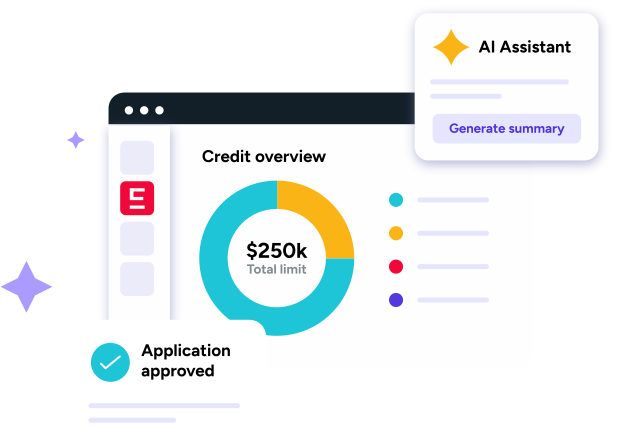
Once again, this is an area of AR where AI fits perfectly as a practical problem-solver. AI-powered solutions can automatically summarize conversations and surface key information, including payment commitments, dispute status, customer concerns, previous actions taken and outstanding follow-ups. They can also go a step further by recommending the next best action based on the context of the conversation.
These recommendations can include:
- Logging a promise to pay
- Creating or updating a dispute
- Escalating a customer issue
- Sending a follow-up communication
- Requesting additional documentation
AI reduces administrative effort while helping ensure important actions do not fall through the cracks. Less time spent reviewing conversation history means more time available to resolve issues.
Roi calculator
See how much you can save with Esker's automation solutions

4. Drafting customer responses
Every collector understands that customer communication requires both speed and consistency. However, many inquiries involve time-consuming requests for information that is not always readily available to the collector. This can include invoice copies, payment status updates, balance clarifications, dispute follow-ups and more.
AI simplifies this often-arduous process by generating suggested responses based on the context of the conversation. This helps collectors respond rapidly while maintaining a consistent tone and message. Human review remains an essential part of the process; the role of AI is to significantly reduce the time normally required to compose routine communications.
The result delivers benefits that collectors and their companies both value:
- Faster response times
- Improved customer experience
- More consistent messaging
- More time available for strategic collections work
Instead of starting from a blank page, collectors start with a draft.
5. Extracting remittance information to improve collections visibility
For better or worse, cash application and collections are often managed by separate teams. Yet collections effectiveness depends heavily on cash application accuracy. When remittance information is difficult to process or payments remain unapplied, collectors risk spending time chasing invoices that have already been paid or working from incomplete information.
AI-powered automation solutions are built to seamlessly bridge this gap. By automatically identifying, capturing and extracting remittance information from emails and supporting documents, AI dramatically reduces manual effort while accelerating payment allocation.
This creates benefits beyond cash application itself. It helps collections operate from a more accurate and up-to-date view of receivables by providing:
- Faster cash posting
- Reduced unapplied cash
- More accurate open-item visibility
- Better collections prioritization
A more efficient cash application process ultimately helps collectors focus on what truly requires attention.
The future of collections: working smarter, collecting faster
When repetitive tasks such as prioritization, payment prediction, communication management and data extraction are automated, AR professionals can focus on the work that creates the greatest impact:
- Building customer relationships
- Resolving disputes
- Managing payment risk
- Improving customer experience
- Accelerating cash collection
As AR teams are asked to handle growing workloads without proportional increases in headcount, AI offers a practical path forward.
The most successful AR organizations are not using AI to replace collectors. They are using AI-powered automation solutions to eliminate low-value activities that consume time and attention, allowing experienced professionals to work smarter, strengthen customer relationships and collect cash faster.
Interested in learning more?
Contact us now to see how Esker's solutions can help your business