

 English US
 English UK
 English AU
 English SG
 Français
 Deutsch
 Italiano
 Español
 Nederlands
Electronic invoicing in Germany
Prepare for Germany's B2B e-invoicing mandate with a clear understanding of the local framework, key milestones and compliance requirements. The German Federal Ministry of Finance (BMF) is phasing in mandatory domestic B2B electronic invoicing. Since January 2025, VAT-liable businesses within the defined scope must be able to receive e-invoices. Beginning January 2027, large and mid-sized companies will be required to issue e-invoices, with SMEs and microbusinesses following as of January 2028.
*This page is intended as a practical overview only. Requirements, rules, timelines and technical specifications may change as the regulation evolves.



Germany B2B e-invoicing requirements at a glance
From e-invoicing model selection to rollout timing, here are the key aspects businesses need to consider:
Current status — Adoption of legal framework
Germany adopted the Growth Opportunities Act (Wachstumschancengesetz) in 2024, establishing the regulatory basis for mandatory B2B e-invoicing.
Scope — Domestic B2B transactions
The reform covers domestic B2B invoice exchange.
Format — EN16931 format
All invoice formats in compliance with the European Union’s EN 16931 standard are permitted. These include: XRechnung (UBL or CII) and ZUGFeRD (hybrid XML/PDF format).
EDI formats are also permitted, provided they contain an EN 16931-compliant data set. The Senders and recipients can mutually agree on which format to use.
Archiving — 10 years
Invoices must be archived for 10 years starting at the end of fiscal year.
Transmission method — Email, Peppol and other compliant channels
E-invoices may be sent via email, Peppol or any other compliant transmission method.
Germany e-invoicing timeline & key dates
In 2024, Germany’s Ministry of Finance (BMF) confirmed the phased rollout for B2B e-invoicing regulations. Businesses are expected to prepare for the new regulations affecting invoice formats and general compliance standards.

January 2025
E-invoice reception: mandatory for all businesses.

January 2027
E-invoice issuance: mandatory for all tax-paying entities with an annual turnover exceeding €800,000.

January 2028
E-invoice issuance: mandatory for all remaining tax-paying entities.
Implementation dates and requirements may evolve as regulations, technical specifications and administrative guidance continue to develop.
Sanctions & compliance risks
Non-compliance may lead to future sanctions
Germany’s B2B e-invoicing reform is expected to include penalties for businesses that fail to comply with any of the VAT-related regulations.
Potential compliance risks may include:
- Failure to issue compliant e-invoices
- Missing reporting or submission obligations
- Failure to connect to the future public e-invoicing infrastructure
- Insufficient invoice traceability or archiving requirement
EBOOK
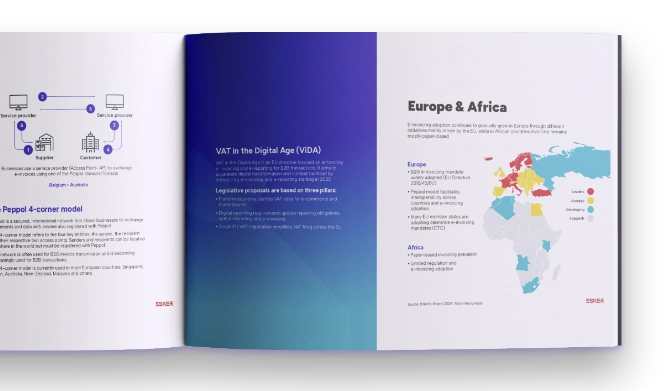
Get the guide to Germany’s e-invoicing reform
Learn more about Germany’s e-invoicing regulations, rollout timeline and important specifications to pay attention to.
What Germany’s e-invoicing reform changes for businesses
Germany’s new legal framework changes how invoice data is exchanged, routed, and reported. Businesses need to adhere to the correct operational setup and compliance model to ensure a smooth rollout.
Anticipate operational changes
Germany’s mandate will affect how teams manage invoice data, workflows and trading partner interactions.Early preparation can help reduce disruption once the reform takes effect.
- Review invoice content, data and required fields
- Align ERP and invoicing workflows
- Coordinate customer and supplier invoicing processes
- Ensure invoice traceability and archiving requirement

Choose the right compliance approach
Germany’s model introduces specific requirements around certified platforms, structured formats, and the exchange model. Businesses need an approach that supports the local regulatory framework while remaining scalable over time.
- Support local invoice formats
- Connect to the right platform environment
- Manage interoperability and invoice exchange requirements
- Scale with future regulatory changes
Why Esker for e-invoicing in Germany
Choosing the right electronic invoicing solution in Germany is about more than meeting regulatory requirements. Businesses need a platform that supports local compliance while improving visibility, control and efficiency across invoice operations.
Built for customer and supplier invoice workflows
Esker supports both customer invoice issuance and supplier invoice processing within a single integrated platform.
Designed for compliance and interoperability
Esker helps businesses manage structured invoice formats, certified platform environments, interoperability requirements and evolving German e-invoicing obligations through one scalable platform.
Enable broader finance transformation initiatives
Esker extends e-invoicing readiness into wider accounts payable, accounts receivable, source-to-pay and order-to-cash transformation projects across the business.
Prepare for future EU regulatory changes (ViDA)
Prepared for the upcoming VAT in the Digital Age (ViDA) initiative, enabling businesses to adapt to harmonized EU e-invoicing requirements.
Esker helps businesses prepare for upcoming initiatives such as VAT in the Digital Age (ViDA) and adapt more easily to harmonized EU e-invoicing requirements.
Send us a message
Please fill in the form below to get in touch with us.
Anticipate the reform today
Automate processes now, activate compliance when required
Deploy Esker Accounts Payable and Esker Invoice Delivery solutions ahead of Germany’s e-invoicing mandate to streamline invoice operations, improve visibility and prepare your business for future compliance requirements.
When the reform becomes applicable, activate the required German e-invoicing compliance capabilities within the same scalable environment.
Key benefits:

Improve supplier and customer invoice processes today

Strengthen invoice data quality and workflow foundations

Prepare for platform and interoperability requirements

Activate German compliance capabilities when needed



Frequently asked questions
What is the status of e-invoicing regulations in Germany?
Germany is introducing mandatory electronic invoicing for domestic B2B transactions. An e-invoice is a structured digital invoice in a machine-readable format such as XRechnung or ZUGFeRD, not just a PDF sent by email.
Since January 2025, all businesses registered in Germany must be able to receive e-invoices. Starting in January 2027, companies with an annual turnover above €800,000 will be required to issue e-invoices. In January 2028, these requirements will apply to almost all domestic B2B transactions.
The aim of this legal framework is to automate accounting processes, reduce VAT fraud, and improve invoice processing efficiency. Once the regulations take effect, a PDF invoice will no longer be compliant for B2B transactions.
E-invoicing is already mandatory for many B2G (Business-to-Government) transactions that involve public sector entities, although not all German federal states are concerned. In Germany, public authorities typically require invoices in the XRechnung format, which can be submitted through the OZG-RE platform (Online Access Act-compliant Invoice Submission Platform).
Is e-invoicing mandatory in Germany?
Yes. Germany is making e-invoicing mandatory for domestic B2B transactions and is introduced in phases.
Since January 2025, all businesses registered in Germany must be able to receive e-invoices. Starting in January 2027, companies with an annual turnover above €800,000 will be required to issue e-invoices. In January 2028, these requirements will apply to almost all domestic B2B transactions.
A PDF invoice will no longer be sufficient because the data must be machine-readable and compliant with the European EN 16931 standard.
E-invoicing is already mandatory for many B2G (Business-to-Government) transactions that involve public sector entities. The required format in these cases is XRechnung, but the official OZG-RE (OZG-compliant Invoice Submission Platform) platform can also be used.
What does Germany’s e-invoicing model look like?
Germany uses a decentralized e-invoicing model based on EN 16931-compliant formats such as XRechnung and ZUGFeRD. Invoices can be transmitted via all applicable methods, provided that authenticity, integrity, and immutability requirements are ensured. There is no mandatory governmental clearance step for B2B transactions.
What are the XRechnung or ZUGFeRD e-invoicing?
The main e-invoicing formats used in Germany are XRechnung and ZUGFeRD, which are both compliant with the European Union’s EN 16931 standard.
XRechnung is a fully structured XML format mainly used for B2G transactions (Business-to-Government), and widely accepted for B2B transactions as well. It contains only machine-readable data and no visual PDF layout.
ZUGFeRD is a hybrid format combining a human-readable PDF with an embedded XML file. It is the preferred method in the private sector because it can be read by humans and accounting software. ZUGFeRD is based on the same hybrid model as Factur-X, the Franco-German e-invoicing standard developed jointly by France and Germany.
Both formats include structured data, such as supplier and customer details, VAT information, invoice lines, tax amounts, payment terms, and totals, which enables fully automated processing by ERPs and accounting systems.
During the transition phase, paper invoices and non-structured electronic formats are permitted.
Archiving requirement: invoices must be archived for 10 years for tax and VAT purposes. This applies to both paper and electronic invoices.
E-invoices must be stored in their original electronic format to ensure authenticity, integrity, readability, and accessibility throughout the retention period.
Businesses must also comply with the German GoBD rules governing digital record-keeping and auditability.
Is Peppol mandatory for e-invoicing in Germany?
Peppol is not mandatory for e-invoicing in Germany.
The legal requirement is the use of structured e-invoice formats that are compliant with the EN 16931 standard, such as XRechnung or ZUGFeRD. Peppol is an authorized transmission network.
Peppol is, however, widely used for B2G invoicing, as many German public authorities accept and/or prefer XRechnung invoices transmitted via Peppol. For B2B transactions it remains optional, unless required by a trading partner.