

 English US
 English UK
 English AU
 English SG
 Français
 Deutsch
 Italiano
 Español
 Nederlands
Applying Maslow’s Hierarchy of Needs to Business Operations: How Automation Can Shape a Better Organizational Culture

Maslow’s Hierarchy of Needs was designed to explain human motivation. More than 80 years later, it also offers a surprisingly useful framework for thinking about how businesses evolve.
Like people, organizations have fundamental needs that must be addressed before they can focus on higher ambitions. They need cash to operate. They need stability and control. They depend on strong relationships with customers, suppliers and employees. And ultimately, they need the capacity to innovate, grow and create long-term value.
What has changed is how businesses can meet those needs.
Automation has already transformed many Source-to-Pay (S2P) and Order-to-Cash (O2C) processes. Now, AI and AI agents are pushing that transformation further. Instead of simply helping people complete tasks faster, technology can increasingly execute routine work, identify what needs attention and support people when human judgment is required.
That makes Maslow’s hierarchy particularly relevant to the next generation of business transformation.
How Maslow’s Hierarchy of Needs Applies to Business
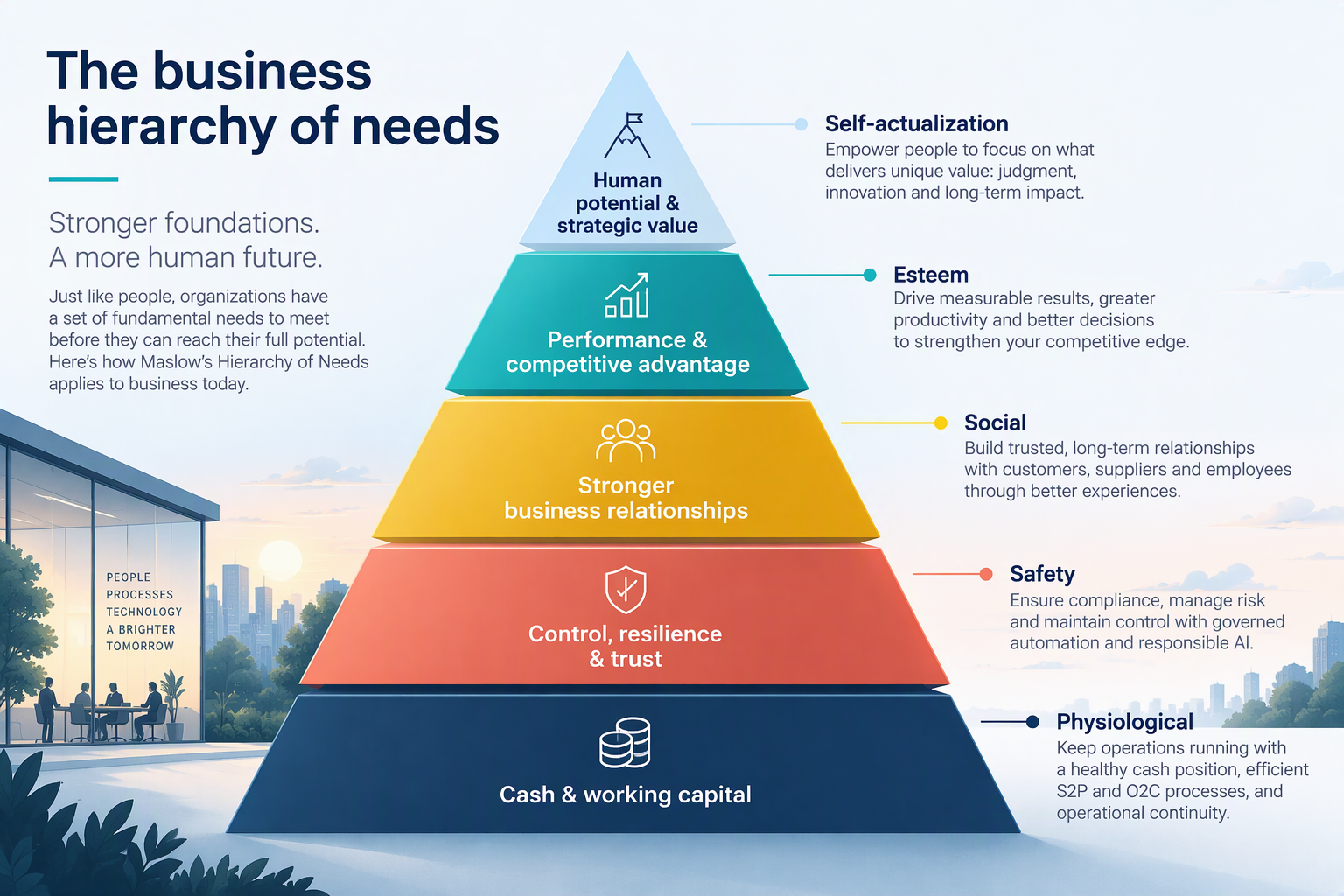
Maslow organized human needs into five levels: physiological, safety, social, esteem and self-actualization. A similar hierarchy can be applied to business.
1. Physiological needs: Protecting cash and keeping the business moving
For people, physiological needs include essentials such as food, water and shelter. For businesses, the equivalent is financial and operational viability.
Organizations need sufficient cash and working capital to pay suppliers and employees, fulfill customer demand and continue investing in growth. This is where core S2P and O2C processes play a fundamental role.
On the purchasing side, organizations need visibility and control over spending, supplier relationships and payments. On the customer side, they need to process orders efficiently, invoice accurately, collect cash and manage credit risk.
Automation helps remove many of the delays, errors and manual interventions that can slow these processes down. AI can take this further by helping prioritize work, handle routine execution and surface situations that require human attention.
The objective is simple: keep cash and operations moving without requiring people to manually push every process forward.
2. Safety needs: Building control, resilience and trust
Once fundamental needs are met, Maslow’s second level focuses on safety, stability and protection. The same principle applies to business.
Speed alone has little value if an organization loses control over how decisions are made. This becomes even more important as AI takes on a greater role in operational and financial processes.
That is why the next step in automation is not unlimited autonomy. It is governed autonomy.
AI agents can take on specific tasks and support execution while operating within the rules, permissions and approval boundaries defined by the business. People remain in control of where autonomy is appropriate and where human oversight is required.
A routine transaction may require very little human intervention. A complex exception, credit decision or higher-risk situation may require significantly more.
The objective is not to remove people from the process. It is to make human involvement intentional rather than systematic.
3. Social needs: Creating stronger business relationships
Maslow’s social needs revolve around connection, belonging and relationships. Businesses depend on relationships too.
Customers expect fast, accurate service. Suppliers depend on predictable communication and payments. Employees want tools that help them accomplish meaningful work rather than forcing them to navigate repetitive administrative tasks.
This is where automation needs to be evaluated differently. A successful transformation should not simply reduce processing time. It should improve the experience surrounding the process.
For Customer Service teams, that might mean spending less time manually retrieving information and more time resolving complex customer requests.
For Accounts Receivable, it can mean directing collectors toward the accounts and conversations that genuinely deserve attention rather than treating every outstanding invoice in the same way.
For Procurement or Accounts Payable, it can mean reducing repetitive processing so teams can focus on suppliers, exceptions and strategic decisions.
As technology takes care of more routine execution, people can spend more time on the interactions where context, empathy, negotiation and judgment genuinely matter.
4. Esteem needs: Turning efficiency into business performance
Maslow associated esteem with achievement, confidence and recognition. For an organization, reaching this level means moving beyond simply keeping processes operational.
The question becomes: How can better execution contribute to better business performance?
That could mean accelerating cash conversion, improving productivity, helping teams manage greater volumes, making better-informed decisions or increasing operational capacity without proportionally increasing manual work.
This represents an important evolution from traditional process automation.
AI should not simply identify a problem or tell people what they could do next. When appropriate, AI agents can help move work forward, coordinate actions and support execution across business processes.
The next generation of AI should not simply recommend work. It should help get the work done.
5. Self-actualization: Moving human work higher up the value chain
At the top of Maslow’s hierarchy is self-actualization: the ability to realize one’s potential.
This may be where the comparison with business becomes most interesting.
For decades, business technology has promised to free employees from repetitive work. Yet many professionals still spend significant portions of their day reviewing queues, moving information between systems, checking routine transactions and deciding what to work on next.
AI agents create an opportunity to rethink that division of work.
Routine and rules-based execution can increasingly be handled by technology, while people remain essential for exceptions, negotiations, risk decisions, strategic choices and the situations where experience and judgment matter most.
The ambition is not necessarily to automate everything.
It is to determine what technology should execute, what requires human judgment and how the two can work together effectively.
When routine execution requires less human attention, Finance, Procurement and Customer Service professionals can focus more of their time on understanding problems, improving decisions, managing relationships and shaping strategy.
From Automation to Human-Governed Autonomy
There is one important difference between applying Maslow’s hierarchy to humans and applying it to organizations.
Businesses do not permanently “complete” one level before moving to the next.
Cash, risk, relationships and performance need continuous attention. What changes is the organization’s ability to manage those needs efficiently enough to focus resources elsewhere.
That is why the evolution from traditional automation to AI agents matters.
Traditional automation helped businesses remove manual steps from processes. AI made it possible to better understand information, detect patterns, predict outcomes and recommend actions.
AI agents introduce another possibility: technology that can execute work within defined boundaries while people retain governance over the outcome.
Within Esker solutions, this evolution is taking shape through Synergy AI Agents, designed to support and execute work across Source-to-Pay and Order-to-Cash processes while keeping people in control of the decisions and exceptions that require human expertise.
The result should not be fewer humans involved in business. It should be better use of human attention.
The Real Goal: Making Room for Better Work
Maslow’s theory ultimately describes progression.
Once we spend less energy securing our fundamental needs, we gain the freedom to pursue something more valuable.
Businesses are not so different.
When cash is under control, processes are resilient, relationships are healthy and routine execution no longer consumes a disproportionate amount of human attention, organizations create room for something else: better decisions, stronger relationships, innovation and strategic thinking.
That may ultimately be one of the most important promises of AI in business.
Not replacing human expertise.
Not automating for the sake of automation.
But creating an environment where technology handles more of the execution, so people can spend more time on the work where being human actually matters.